
Latest ads
-
 AWS Certified Solutions Architect-Associate + AWS Certified Cloud Practitioner
- Sanjeewani95
- Updated:
-
 🚀 එක පැකේජ් එකයි - මාසෙටම Unlimited Internet! 🌐
- sayuru bandara
- Updated:
-
 🎬 CapCut Pro 1 Month Access! LKR 600
- sayuru bandara
- Updated:
-
 🚀 Google One AI PRO Plan (Gemini Pro Activation) – 18 Months Access! LKR 2200
- sayuru bandara
- Updated:
මෝටර් රථයට ගොඩවූ වහාම එහි වායුසමීකරණය පණ Ş
- Thread starter hansa1018
- Start date
You are using an out of date browser. It may not display this or other websites correctly.
You should upgrade or use an alternative browser.
You should upgrade or use an alternative browser.


Machan good post add this to your post..
Agent Characteristics
Signs/Symptoms
http://www.cdc.gov/niosh/ershdb/EmergencyResponseCard_29750032.html#top
Agent Characteristics

- APPEARANCE: Clear, colorless to light yellow liquid at room temperature. Benzene is a solid below 42°F (5.6°C).
- DESCRIPTION: Benzene is used to make chemicals used in the manufacture of industrial products such as dyes, detergents, explosives, pesticides, synthetic rubber, plastics, and pharmaceuticals. Benzene is found in gasoline and trace amounts are found in cigarette smoke. Benzene has been banned as an ingredient in products intended for use in the home, including toys. Benzene has a sweet, aromatic, gasoline-like odor. Most individuals can begin to smell benzene in air at 1.5 to 4.7 ppm. The odor threshold generally provides adequate warning for acutely hazardous exposure concentrations but is inadequate for more chronic exposures.
- METHODS OF DISSEMINATION:
- Indoor Air: Benzene can be released into indoor air as a liquid spray (aerosol), mist, or vapor.
- Water: Benzene can be used to contaminate water.
- Food: Benzene can be used to contaminate food.
- Outdoor Air: Benzene can be released into outdoor air as a liquid spray (aerosol), mist, or vapor.
- Agricultural: If benzene is released into the air as a mist, it has the potential to contaminate agricultural products.
- ROUTES OF EXPOSURE: Benzene can be absorbed into the body by inhalation, ingestion, or skin contact. Inhalation is an important route of exposure.
- GENERAL INFORMATION: First Responders should use a NIOSH-certified Chemical, Biological, Radiological, Nuclear (CBRN) Self Contained Breathing Apparatus (SCBA) with a Level A protective suit when entering an area with an unknown contaminant or when entering an area where the concentration of the contaminant is unknown. Level A protection should be used until monitoring results confirm the contaminant and the concentration of the contaminant.
NOTE: Safe use of protective clothing and equipment requires specific skills developed through training and experience.
- LEVEL A: (RED ZONE): Select when the greatest level of skin, respiratory, and eye protection is required. This is the maximum protection for workers in danger of exposure to unknown chemical hazards or levels above the IDLH or greater than the AEGL-2.
- A NIOSH-certified CBRN full-face-piece SCBA operated in a pressure-demand mode or a pressure-demand supplied air hose respirator with an auxiliary escape bottle.
- A Totally-Encapsulating Chemical Protective (TECP) suit that provides protection against CBRN agents.
- Chemical-resistant gloves (outer).
- Chemical-resistant gloves (inner).
- Chemical-resistant boots with a steel toe and shank.
- Coveralls, long underwear, and a hard hat worn under the TECP suit are optional items.
- LEVEL B: (RED ZONE): Select when the highest level of respiratory protection is necessary but a lesser level of skin protection is required. This is the minimum protection for workers in danger of exposure to unknown chemical hazards or levels above the IDLH or greater than AEGL-2. It differs from Level A in that it incorporates a non-encapsulating, splash-protective, chemical-resistant splash suit that provides Level A protection against liquids but is not airtight.
- A NIOSH-certified CBRN full-face-piece SCBA operated in a pressure-demand mode or a pressure-demand supplied air hose respirator with an auxiliary escape bottle.
- A hooded chemical-resistant suit that provides protection against CBRN agents.
- Chemical-resistant gloves (outer).
- Chemical-resistant gloves (inner).
- Chemical-resistant boots with a steel toe and shank.
- Coveralls, long underwear, a hard hat worn under the chemical-resistant suit, and chemical-resistant disposable boot-covers worn over the chemical-resistant suit are optional items.
- LEVEL C: (YELLOW ZONE): Select when the contaminant and concentration of the contaminant are known and the respiratory protection criteria factors for using Air Purifying Respirators (APR) or Powered Air Purifying Respirators (PAPR) are met. This level is appropriate when decontaminating patient/victims.
- A NIOSH-certified CBRN tight-fitting APR with a canister-type gas mask or CBRN PAPR for air levels greater than AEGL-2.
- A NIOSH-certified CBRN PAPR with a loose-fitting face-piece, hood, or helmet and a filter or a combination organic vapor, acid gas, and particulate cartridge/filter combination or a continuous flow respirator for air levels greater than AEGL-1.
- A hooded chemical-resistant suit that provides protection against CBRN agents.
- Chemical-resistant gloves (outer).
- Chemical-resistant gloves (inner).
- Chemical-resistant boots with a steel toe and shank.
- Escape mask, face shield, coveralls, long underwear, a hard hat worn under the chemical-resistant suit, and chemical-resistant disposable boot-covers worn over the chemical-resistant suit are optional items.
- LEVEL D: (GREEN ZONE): Select when the contaminant and concentration of the contaminant are known and the concentration is below the appropriate occupational exposure limit or less than AEGL-1 for the stated duration times.
- Limited to coveralls or other work clothes, boots, and gloves.
- CHEMICAL DANGERS:
- See Explosion Hazards.
- EXPLOSION HAZARDS:
- Benzene reacts violently with oxidants and halogens, causing an explosion hazard.
- Benzene poses a vapor explosion hazard indoors, outdoors, or in sewers.
- Vapors may form explosive mixtures with air.
- Run-off to sewers may create an explosion hazard.
- Containers may explode when heated.
- Lower explosive (flammable) limit in air (LEL), 1.2%; upper explosive (flammable) limit in air (UEL), 7.8%.
- FIRE FIGHTING INFORMATION:
- Benzene is highly flammable.
- The agent will be easily ignited by heat, sparks, or flames.
- Fire will produce irritating, corrosive, and/or toxic gases.
- Benzene reacts violently with oxidants and halogens, causing a fire hazard.
- Vapors may travel to the source of ignition and flash back.
- Run-off to sewers may create a fire hazard.
- Caution: The agent has a very low flash point. Use of water spray when fighting fires may be inefficient.
- For small fires, use dry chemical, carbon dioxide, water spray, or regular foam.
- For large fires, use water spray, fog, or regular foam. Do not use straight streams. Move containers from the fire area if it is possible to do so without risk to personnel.
- For fire involving tanks or car/trailer loads, fight the fire from maximum distance or use unmanned hose holders or monitor nozzles. Cool containers with flooding quantities of water until well after the fire is out. Withdraw immediately in case of rising sound from venting safety devices or discoloration of tanks. Always stay away from tanks engulfed in fire.
- For massive fire, use unmanned hose holders or monitor nozzles; if this is impossible, withdraw from the area and let the fire burn.
- Run-off from fire control or dilution water may cause pollution.
- If the situation allows, control and properly dispose of run-off (effluent).
- INITIAL ISOLATION AND PROTECTIVE ACTION DISTANCES:
- If a tank, rail car, or tank truck is involved in a fire, isolate it for 0.5 mi (800 m) in all directions; also consider initial evacuation for 0.5 mi (800 m) in all directions.
- This agent is not included in the DOT ERG 2004 Table of Initial Isolation and Protective Action Distances.
- In the DOT ERG 2004 orange-bordered section of the guidebook, there are public safety recommendations to isolate a benzene (Guide 130) spill or leak area immediately for at least 150 ft (50 m) in all directions. For a large spill, consider initial downwind evacuation of at least 1000 ft (300 m).
- PHYSICAL DANGERS:
- Benzene vapors are heavier than air. They will spread along the ground and collect and stay in poorly-ventilated, low-lying, or confined areas (e.g., sewers, basements, and tanks).
- Hazardous concentrations may develop quickly in enclosed, poorly-ventilated, or low-lying areas. Keep out of these areas. Stay upwind.
- Benzene liquid is less dense than water and will float on the surface of water.
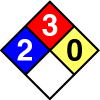
- NFPA 704 Signal:
- Health: 2
- Flammability: 3
- Reactivity: 0
- Special:
Signs/Symptoms
- TIME COURSE: Central nervous system (CNS) depression can occur immediately following inhalation of benzene vapors. Gastrointestinal (GI) irritation and CNS depression can occur between 30 and 60 minutes after benzene has been ingested. Loss of consciousness usually resolves once the patient/victim has been removed from the source of exposure, but may be prolonged. Patient/victims who have ingested benzene must be watched for a minimum of 72 hours to rule out the possibility of aspiration pneumonitis (inflammation of the lungs caused by inhalation of a chemical). Full recovery from benzene exposure may take from 1 - 4 weeks.
- EFFECTS OF SHORT-TERM (LESS THAN 8-HOURS) EXPOSURE: Benzene vapors are irritating to the respiratory tract and eyes. Breathing benzene vapors results in adverse health effects related to the central nervous system including drowsiness, dizziness, rapid heart rate, headache, lightheadedness, nausea, tremors, impaired gait, confusion, loss of consciousness, shortness of breath, respiratory depression, coma, and possibly death. Ingestion of benzene causes irritation of the gastrointestinal tract, nausea, vomiting, stomach pain, diarrhea, dizziness, sleepiness, seizures, rapid heart rate, and death.
- EYE EXPOSURE:
- High concentrations of vapor: Irritation and blurred vision.
- Liquid: Burning pain and possibly reversible loss (sloughing) and injury to the surface of the cornea.
- INGESTION EXPOSURE:
- Nine to 12 g: Irritation of the stomach causing nausea, vomiting (emesis), and diarrhea; burning sensation to the mouth, esophagus, and stomach; abnormally rapid heart rate (tachycardia); staggering gait, drowsiness (somnolence), loss of consciousness, or altered mental status; and inflammation of the lungs and respiratory failure.
- Slightly higher ingested doses: Dizziness and excitation followed by a flushed appearance, difficulty breathing or shortness of breath (dyspnea), feeling of chest tightness, headache, and generalized weakness.
- At the highest ingested doses: In addition to the above adverse health effects, symptoms include euphoria and excitation followed by fatigue, coma, and death.
- INHALATION EXPOSURE:
- 700 to 3,000 ppm: Drowsiness, dizziness, headaches, tremors, confusion, unconsciousness, abnormally rapid heart rate (tachycardia), and irritation of the moist linings (mucous membranes of the respiratory tract).
- 3,000 ppm and above: Slow and shallow breathing; a deeper level of unconsciousness, due to narcotic-like action on the CNS; and with prolonged exposures, seizures, paralysis, abnormal (potentially fatal) heart rhythms (cardiac arrhythmia), and cessation of breathing (apnea).
- 20,000 ppm for 5 minutes: Cessation of breathing (apnea) due to accumulation of fluid in the lungs (pulmonary edema).
- If benzene is ingested and vomited, inhalation of benzene-containing vomitus into the lungs (aspiration) may cause potentially fatal lung damage.
- SKIN EXPOSURE:
- Mild to moderate: Irritation, redness (erythema), and burning sensation.
- Severe: Fluid accumulation (edema), blistering (vesication), and inflammation (dermatitis).
- Absorption through the skin is slow, but it may contribute to whole-body (systemic) toxicity.
- See Inhalation Exposure
- INTRODUCTION: The purpose of decontamination is to make an individual and/or their equipment safe by physically removing toxic substances quickly and effectively. Care should be taken during decontamination, because absorbed agent can be released from clothing and skin as a gas. Your Incident Commander will provide you with decontaminants specific for the agent released or the agent believed to have been released.
- DECONTAMINATION CORRIDOR: The following are recommendations to protect the first responders from the release area:
- Position the decontamination corridor upwind and uphill of the hot zone. The warm zone should include two decontamination corridors. One decontamination corridor is used to enter the warm zone and the other for exiting the warm zone into the cold zone. The decontamination zone for exiting should be upwind and uphill from the zone used to enter.
- Decontamination area workers should wear appropriate PPE. See the PPE section of this card for detailed information.
- A solution of detergent and water (which should have a pH value of at least 8 but should not exceed a pH value of 10.5) should be available for use in decontamination procedures. Soft brushes should be available to remove contamination from the PPE. Labeled, durable 6-mil polyethylene bags should be available for disposal of contaminated PPE.
- INDIVIDUAL DECONTAMINATION: The following methods can be used to decontaminate an individual:
- Decontamination of First Responder:
- Begin washing PPE of the first responder using soap and water solution and a soft brush. Always move in a downward motion (from head to toe). Make sure to get into all areas, especially folds in the clothing. Wash and rinse (using cold or warm water) until the contaminant is thoroughly removed.
- Remove PPE by rolling downward (from head to toe) and avoid pulling PPE off over the head. Remove the SCBA after other PPE has been removed.
- Place all PPE in labeled durable 6-mil polyethylene bags.
- Decontamination of Patient/Victim:
- Remove the patient/victim from the contaminated area and into the decontamination corridor.
- Remove all clothing (at least down to their undergarments) and place the clothing in a labeled durable 6-mil polyethylene bag.
- Thoroughly wash and rinse (using cold or warm water) the contaminated skin of the patient/victim using a soap and water solution. Be careful not to break the patient/victim's skin during the decontamination process, and cover all open wounds.
- Cover the patient/victim to prevent shock and loss of body heat.
- Move the patient/victim to an area where emergency medical treatment can be provided.
- Decontamination of First Responder:
http://www.cdc.gov/niosh/ershdb/EmergencyResponseCard_29750032.html#top
බෙන්සන් නෙමෙයි, මේ ඇරෝමැටික වලයට සිංහලෙන් කියන්නෙ බෙන්සීන් කියලා. බෙන්සීන් විතරක් නෙමෙයි. ඕනෑම ඇරෝමැටික කාබනික රසායනිකයක් පිළිකාකාරකයක් ලෙස ක්රියා කරන්න පුලුවන්.


bump
බන්ටු;13532505 said:ෆට්ට.. Rep කලින් දීලලු මචෝ..
(කම්මැලියි යකෝ කියවන්න )

elaazz..........
riduna........

thanks machan
good advice
ela thank u
bump
bump
very gud post machan
rep denna baa lu
Machan good post add this to your post..
bump
Thanx for sharing machan....!
valuable info....
bump
patta thread ekak.
niyamayi
RePost බුවා;13535873 said:
ela eal
bump
appata hudu
good post
+4 bump
නාකි ඉලන්දාරියා;13536364 said:bump
thnx all broz............
elaazz..............


වටිනා ලිපියක්. ඔයා මේ වගේ ලිපි කීපයක්ම දැම්මා. මං ගොඩක් ඒවා බැලුවා. ගොඩක් වටිනවා. කණගාටුයි ඔයාට රෙප් දෙන්න බෑලු. කලින් දීල.
දිගටම කරගෙන යන්න.
දිගටම කරගෙන යන්න.

good post
hmmmmmmmmmmmmm
elaazz..............
වටිනා ලිපියක්. ඔයා මේ වගේ ලිපි කීපයක්ම දැම්මා. මං ගොඩක් ඒවා බැලුවා. ගොඩක් වටිනවා. කණගාටුයි ඔයාට රෙප් දෙන්න බෑලු. කලින් දීල.
දිගටම කරගෙන යන්න.
එලකිරි සහෝ..............
රෙප් නැතුවට අවුලක් නැහැ........
ඇගයීම වටිනවා.........
Similar threads

- Replies
- 10
- Views
- 531


- Replies
- 23
- Views
- 1K

- Replies
- 19
- Views
- 1K
