


Latest ads
-
 ඕනම රටකට සෙට් වෙන CV එකක්
- ErMurazor
- Updated:
-
 Hambantota 7 Acres Beachfront Land For Sell DownSouth , PerPerch Price 420 000
- 1024 Digital
- Updated:
-
 Baseus PI LITE INDOOR CAMERA
- ErMurazor
- Updated:
-
Colombo Hard Disk For Sale
- mazza
- Updated:
You are using an out of date browser. It may not display this or other websites correctly.
You should upgrade or use an alternative browser.
You should upgrade or use an alternative browser.


Top 10 cellular phones
01.Motorola Droid: Impressive Features, Gorgeous Hardware

The first time you pick up the Motorola Droid ($200 with a two-year contract from Verizon; price as of 10/28/09), you'll notice its solid feel and heft--there's a lot going on behind the crisp, 3.7-inch touchscreen. Making good use of Android 2.0's new features, the Droid is a powerful Web surfing and communications tool that has a chance of living up to its hype. The Droid's biggest flaw, however, is in its hardware design: The keyboard is shallow and flat, which can make typing uncomfortable.
At 0.54 inch thick, the Droid is slightly beefier than the 0.48-inch-thick iPhone 3GS, but it still has room for a 40-key, slide-out QWERTY keypad. At just under 6 ounces, it's about an ounce heftier than the iPhone 3GS. When closed, the 4.56-by-2.36-inch Droid is almost the same size as the 4.5-by-2.4-inch iPhone 3GS.
Motorola is quick to point out that the Droid's 480-by-854-pixel display offers 409,920 pixels, more than double the 153,600 pixels that the 480-by-320-pixel, 3.5-inch screen on the iPhone 3GS offers. The Droid's resolution also compares well against that of Android 1.6-based phones such as T-Mobile's myTouch 3G, which has a 3.2-inch, 480-by-320-pixel display.
02.Apple iPhone 3GS
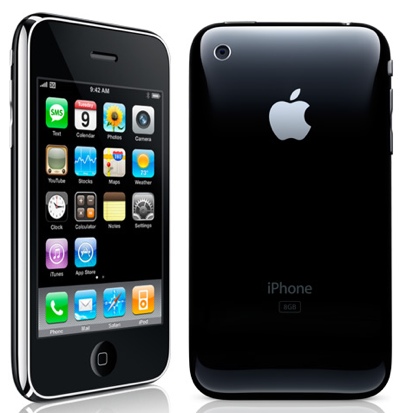
It would be easy to dismiss the Apple iPhone 3GS as an inconsequential hardware upgrade. But to do so would underestimate how much, collectively, the phone's new features augment the iPhone experience. With the iPhone 3GS, Apple solidifies its leadership position in a crowded smartphone landscape.
On the outside, the iPhone 3GS ($299 for 32GB, or $199 for 16GB, with a two-year AT&T contract, as of 6/22/09) looks and feels virtually identical to the existing iPhone 3G (now $99 for 8GB with a two-year AT&T contract). Yes, it's disappointing that Apple made no refinements in the external case (see our review of the iPhone 3G for more detail, but it's simply a minimalist design dominated by its display and the home button beneath that display). And yes, it's curious that the colors remain the same, black or white gloss (this from the company which made sure its audio players came in every color of the spectrum).
But inside, the iPhone 3GS has been fully redesigned, with new core components (CPU, memory, integrated compass, video recorder) in different locations, no less. And together with the iPhone OS 3.0 upgrade (which makes many compelling features available to existing iPhone customers), the iPhone 3GS stands tall. After pounding on it, I can say that at the full-subsidy prices, the 3GS is a surprisingly worthy upgrade for heavy users of the phone's Web and gaming capabilities, and for general-use apps--even if you're only jumping from the iPhone 3G
03.Motorola Cliq (T-Mobile)

The Motorola Cliq ($200 with a two-year contract from T-Mobile) caught my attention because of its sleek design and its innovative MotoBlur overlay for Android. Overall, the new features lived up to my expectations, and I applaud Motorola for doing something different to separate itself from the Android pack. The Cliq isn't perfect, however: Its camera disappoints, and it doesn't ship with the latest version of Android.
Like the T-Mobile G1 and the Samsung Moment, the Motorola Cliq has both a touchscreen and a slide-out keyboard. I haven't spent enough time with the Samsung Moment to compare it and the Cliq in depth, but I can safely say that I much prefer the Cliq to the G1. It feels sturdier, more streamlined, and more comfortable during use.
Measuring 4.5 inches long by 2.3 inches wide by 0.6 inch thick, the Cliq falls somewhere between the G1 and the T-Mobile MyTouch 3G (T-Mobile's other Android offering) in size. Weighing 5.7 ounces, it is slightly heavier than other current smartphones--the iPhone 3GS, for example--but it doesn't feel bulky. The Cliq feels as though it has a high build quality, thanks in part to the glass display and metal trim around the handset.
04.RIM BlackBerry Bold 9700 (T-Mobile) Smartphone

Research In Motion's BlackBerry Bold 9700 ($200 with a two-year T-Mobile contract; price as of 11/4/09) is the finest BlackBerry to date, combining the best of the BlackBerry Tour 9630 and the BlackBerry Bold 9000 in a slim and refined package. People looking for a major update to the original Bold might be disappointed, but BlackBerry fans will appreciate the handset's subtle design tweaks and upgrades.
Measuring 4.3 by 2.4 by 0.6 inches, the 9700 is much more pocketable than the colossal 9000 (which measured 4.5 by 2.6 by 0.6 inches). The new handset is lighter, as well, weighing 4.2 ounces (down from 4.8 ounces). Though the leatherette back is still present, it's minimized on this new version--a good thing. (I'm just not a fan of fake leather on a phone.)
On the right spine are the volume rocker and the camera shutter/convenience key (a function key that you can program to open any app of your choice). On the left side you'll find another convenience key as well as the standard 3.5mm headphone jack and micro-USB port. Lock and mute buttons are at the top of the device. Below the display sits the familiar row of hardware buttons we've become accustomed to seeing on BlackBerrys: Talk, Menu, Back, and End/Power.
05. T-Mobile myTouch 3G

The T-Mobile MyTouch 3G is T-Mobile's second smartphone running Google's Android mobile operating system. And while the MyTouch 3G ($200 as of July 22, 2009) has much going for it-- a lightweight design, a gorgeous screen, and the 1.5 update to the Android operating system, it's not without its flaws -- the on-screen keyboard is far from perfect, for example.
The MyTouch 3G is virtually identical to the HTC Magic, as the handset is called overseas. The phone has an eye-catching design that's what the T-Mobile G1 should have been-it's sleek, elegantly curved, and graced with distinctive design touches. When the G1 first came out, I described it as bland. Viewed side-by-side with the myTouch 3G, the G1 now looks downright kludgy. It feels bulky, too, and no wonder: Though the MyTouch 3G's dimensions are only slightly smaller than the G1 (measures 4.5 by 2.2 by 0.5 inches versus the G1's 4.6 by 2.2 by 0.6 inches), in hand it feels significantly smaller, and it is noticeably lighter (weighing 4.1 ounces versus the G1's 5.6 ounces). The Apple iPhone 3G is taller and slightly slimmer than the myTouch.
06. Palm Pre (Sprint) Smartphone

The glossy-black Pre has a uniquely curved slider body that's dominated by its 3.1-inch, 320-by-480-pixel capacitive touch display. The screen slides up and curves slightly toward you, a design intended to resist glare and make the phone feel comfortable in your hand and against your face. Especially in brightly lit environments, the slight angle made viewing the screen easier than on the average phone. Measuring 3.9 by 2.3 by 0.7 inches, the Pre is incredibly pocketable, more so than a device like Apple's iPhone 3G; it even fits unobtrusively into a woman's jeans pocket, a rare feat for a full-QWERTY smartphone.
Unfortunately, Palm seems to have sacrificed keyboard usability in the interest of compactness. While I appreciated having a physical keyboard, I disliked the design. The vertical slide-out QWERTY keyboard looks and feels much like that on the Palm Centro; here, the keys are glossy black with orange-hued lettering and different colors to designate the embedded keypad. The keys are slightly recessed, however, and I found that the bezel lip on the sides and bottom often interfered with my typing. Furthermore, the top row is a few millimeters too close to the edge of the slider screen, so you have to angle your fingers to press those keys. Though the keyboard slides out smoothly, it also feels a bit flimsy, as if it could snap off with too much use.
07. Samsung Behold II

The Samsung Behold II ($230 with a two-year T-Mobile contract; price as of 11/12/09) smartphone is the latest device to join T-Mobile's growing army of Android phones, which includes the T-Mobile G1, the T-Mobile myTouch 3G, and the Motorola Cliq. Though the Behold II has a gorgeous AMOLED display and a superior camera, customers might be turned off by the high price (it is more expensive than the iPhone 3GS and the Motorola Droid) as well as the somewhat cluttered TouchWiz interface.
While the Behold II is supposed to be an update of the Behold, which debuted last holiday season on T-Mobile, the two phones couldn't be more different. Measuring 4.6 by 2.2 by 0.5 inches and weighing 4.2 ounces, the Behold II is slightly larger than the original (which is 4.1 by 2.2 by 0.5 inches and 3.9 ounces).
Even so, the Behold II is still quite pocketable and light--and with its curved edges and its brown and black color scheme (Samsung calls it "Mystic Brown"), the Behold II is much more attractive than its boxy predecessor. The face of the phone has a small amount of brown brushed metal below the display, while the glossy piano-black backing features a world-map design in a subtle gold color. It sounds a bit strange, but the overall look is quite striking.
08. RIM BlackBerry Tour 9630 (Verizon) Smartphone

The Research in Motion BlackBerry Tour ($200 with a two-year Verizon service contract) fulfills the wish of Verizon and Sprint BlackBerry fans who've waited a long time for a new CDMA BlackBerry device. The Tour melds the best of the BlackBerry Bold and the BlackBerry Curve 8900 into one slick package. Unfortunately, like the BlackBerry Storm (also on Verizon), the Tour lacks Wi-Fi, a disappointing omission for a business-focused device.
In appearance, the Tour shares attributes of the BlackBerry Bold (the other 9000-series phone on AT&T) and of the BlackBerry Curve 8900 (on AT&T and T-Mobile). But it has the same dimensions as the BlackBerry Storm, measuring 4.4 inches by 2.4 inches by 0.5 inch. At 4.6 ounces, the Tour weighs an ounce less than the Storm but is slightly heavier than the feather-light Curve 8900. The Tour felt just right in my hand; the Bold was too large for my liking, and the 8900 was almost too thin. And whereas the Bold looks chintzy and the 8900 a bit dull, the Tour has a subtle elegance: The phone's body combines a muted chrome bezel with smooth black rubber and textured plastic. The texture contributes to the phone's comfortable in-hand feel.
As with most other BlackBerry handsets of the newer generation, the right spine of the Tour houses a 3.5mm headphone jack, a volume rocker, a dedicated camera key (which can be customized to serve as another shortcut) and a mini-USB port (for data transfers and power). The left spine accommodates the voice-dialing key (also customizable) and a speaker.
09. HTC Droid Eris (Verizon)
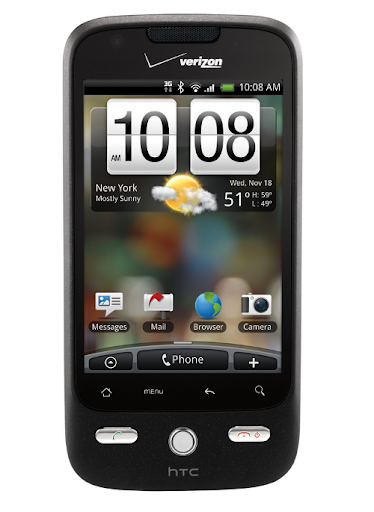
The HTC Droid Eris marks the second in Verizon Wireless's parade of the Droids. Also due this week from Verizon, the Droid Eris ($100 with a two-year contract, price as of 11/5/2009) shares the Droid moniker and many features of competing Android phones, but it also adds some touches that improve the experience for business users.
The Droid Eris touchscreen handset (a CDMA version of the HTC Hero) has dimensions similar to, and much of the same functionality as, the T-Mobile myTouch 3G GSM unit, also made by HTC. Side by side, the first thing that jumps out is the Eris's brighter, sharper-looking display. While both handsets have a 3.2-inch, 480-by-320 pixel screen, the Droid Eris supports 262,000 colors while the myTouch 3G has just 65,000 colors.
Unlike the myTouch 3G, which has six hardware keys on the front plus a roller mouse button, the Eris replaces the top four buttons (Home, Menu, Back, and Search) with embedded softkeys. In practice, the four software keys were usable, but not as easy to activate as their hardware counterparts. I've found the myTouch 3G's real Send and End buttons and roller mouse (which glows if you have an incoming text message or other notification) more useful than the Droid Eris's softkeys when fumbling around in the dark. (The Motorola Droid lacks any front-panel hardware buttons.)
10. HTC Hero (Sprint)

HTC's third Android OS smartphone, the HTC Hero ($180 with a two-year contract from Sprint; price as of 9/23/2009), is a giant leap forward for the company's family of Android phones, both in hardware and software. It isn't without its flaws, however: Performance can be slow, video playback is unreliable, and the touch keyboard isn't the easiest to use. Even so, the Hero is jam-packed with features, and I appreciated all of its easy customization.
Compared with the European Hero, the Sprint-branded version looks like a completely different phone. Its corners are much more rounded, and it no longer has the trademark HTC chin (also seen on the T-Mobile G1). The hardware buttons are rearranged and now surround the trackball, instead of being placed above it. I'm not really a fan of the chin, so I found that these design tweaks actually improve the ergonomics of the phone.
01.Motorola Droid: Impressive Features, Gorgeous Hardware

The first time you pick up the Motorola Droid ($200 with a two-year contract from Verizon; price as of 10/28/09), you'll notice its solid feel and heft--there's a lot going on behind the crisp, 3.7-inch touchscreen. Making good use of Android 2.0's new features, the Droid is a powerful Web surfing and communications tool that has a chance of living up to its hype. The Droid's biggest flaw, however, is in its hardware design: The keyboard is shallow and flat, which can make typing uncomfortable.
At 0.54 inch thick, the Droid is slightly beefier than the 0.48-inch-thick iPhone 3GS, but it still has room for a 40-key, slide-out QWERTY keypad. At just under 6 ounces, it's about an ounce heftier than the iPhone 3GS. When closed, the 4.56-by-2.36-inch Droid is almost the same size as the 4.5-by-2.4-inch iPhone 3GS.
Motorola is quick to point out that the Droid's 480-by-854-pixel display offers 409,920 pixels, more than double the 153,600 pixels that the 480-by-320-pixel, 3.5-inch screen on the iPhone 3GS offers. The Droid's resolution also compares well against that of Android 1.6-based phones such as T-Mobile's myTouch 3G, which has a 3.2-inch, 480-by-320-pixel display.
02.Apple iPhone 3GS
It would be easy to dismiss the Apple iPhone 3GS as an inconsequential hardware upgrade. But to do so would underestimate how much, collectively, the phone's new features augment the iPhone experience. With the iPhone 3GS, Apple solidifies its leadership position in a crowded smartphone landscape.
On the outside, the iPhone 3GS ($299 for 32GB, or $199 for 16GB, with a two-year AT&T contract, as of 6/22/09) looks and feels virtually identical to the existing iPhone 3G (now $99 for 8GB with a two-year AT&T contract). Yes, it's disappointing that Apple made no refinements in the external case (see our review of the iPhone 3G for more detail, but it's simply a minimalist design dominated by its display and the home button beneath that display). And yes, it's curious that the colors remain the same, black or white gloss (this from the company which made sure its audio players came in every color of the spectrum).
But inside, the iPhone 3GS has been fully redesigned, with new core components (CPU, memory, integrated compass, video recorder) in different locations, no less. And together with the iPhone OS 3.0 upgrade (which makes many compelling features available to existing iPhone customers), the iPhone 3GS stands tall. After pounding on it, I can say that at the full-subsidy prices, the 3GS is a surprisingly worthy upgrade for heavy users of the phone's Web and gaming capabilities, and for general-use apps--even if you're only jumping from the iPhone 3G
03.Motorola Cliq (T-Mobile)

The Motorola Cliq ($200 with a two-year contract from T-Mobile) caught my attention because of its sleek design and its innovative MotoBlur overlay for Android. Overall, the new features lived up to my expectations, and I applaud Motorola for doing something different to separate itself from the Android pack. The Cliq isn't perfect, however: Its camera disappoints, and it doesn't ship with the latest version of Android.
Like the T-Mobile G1 and the Samsung Moment, the Motorola Cliq has both a touchscreen and a slide-out keyboard. I haven't spent enough time with the Samsung Moment to compare it and the Cliq in depth, but I can safely say that I much prefer the Cliq to the G1. It feels sturdier, more streamlined, and more comfortable during use.
Measuring 4.5 inches long by 2.3 inches wide by 0.6 inch thick, the Cliq falls somewhere between the G1 and the T-Mobile MyTouch 3G (T-Mobile's other Android offering) in size. Weighing 5.7 ounces, it is slightly heavier than other current smartphones--the iPhone 3GS, for example--but it doesn't feel bulky. The Cliq feels as though it has a high build quality, thanks in part to the glass display and metal trim around the handset.
04.RIM BlackBerry Bold 9700 (T-Mobile) Smartphone

Research In Motion's BlackBerry Bold 9700 ($200 with a two-year T-Mobile contract; price as of 11/4/09) is the finest BlackBerry to date, combining the best of the BlackBerry Tour 9630 and the BlackBerry Bold 9000 in a slim and refined package. People looking for a major update to the original Bold might be disappointed, but BlackBerry fans will appreciate the handset's subtle design tweaks and upgrades.
Measuring 4.3 by 2.4 by 0.6 inches, the 9700 is much more pocketable than the colossal 9000 (which measured 4.5 by 2.6 by 0.6 inches). The new handset is lighter, as well, weighing 4.2 ounces (down from 4.8 ounces). Though the leatherette back is still present, it's minimized on this new version--a good thing. (I'm just not a fan of fake leather on a phone.)
On the right spine are the volume rocker and the camera shutter/convenience key (a function key that you can program to open any app of your choice). On the left side you'll find another convenience key as well as the standard 3.5mm headphone jack and micro-USB port. Lock and mute buttons are at the top of the device. Below the display sits the familiar row of hardware buttons we've become accustomed to seeing on BlackBerrys: Talk, Menu, Back, and End/Power.
05. T-Mobile myTouch 3G

The T-Mobile MyTouch 3G is T-Mobile's second smartphone running Google's Android mobile operating system. And while the MyTouch 3G ($200 as of July 22, 2009) has much going for it-- a lightweight design, a gorgeous screen, and the 1.5 update to the Android operating system, it's not without its flaws -- the on-screen keyboard is far from perfect, for example.
The MyTouch 3G is virtually identical to the HTC Magic, as the handset is called overseas. The phone has an eye-catching design that's what the T-Mobile G1 should have been-it's sleek, elegantly curved, and graced with distinctive design touches. When the G1 first came out, I described it as bland. Viewed side-by-side with the myTouch 3G, the G1 now looks downright kludgy. It feels bulky, too, and no wonder: Though the MyTouch 3G's dimensions are only slightly smaller than the G1 (measures 4.5 by 2.2 by 0.5 inches versus the G1's 4.6 by 2.2 by 0.6 inches), in hand it feels significantly smaller, and it is noticeably lighter (weighing 4.1 ounces versus the G1's 5.6 ounces). The Apple iPhone 3G is taller and slightly slimmer than the myTouch.
06. Palm Pre (Sprint) Smartphone

The glossy-black Pre has a uniquely curved slider body that's dominated by its 3.1-inch, 320-by-480-pixel capacitive touch display. The screen slides up and curves slightly toward you, a design intended to resist glare and make the phone feel comfortable in your hand and against your face. Especially in brightly lit environments, the slight angle made viewing the screen easier than on the average phone. Measuring 3.9 by 2.3 by 0.7 inches, the Pre is incredibly pocketable, more so than a device like Apple's iPhone 3G; it even fits unobtrusively into a woman's jeans pocket, a rare feat for a full-QWERTY smartphone.
Unfortunately, Palm seems to have sacrificed keyboard usability in the interest of compactness. While I appreciated having a physical keyboard, I disliked the design. The vertical slide-out QWERTY keyboard looks and feels much like that on the Palm Centro; here, the keys are glossy black with orange-hued lettering and different colors to designate the embedded keypad. The keys are slightly recessed, however, and I found that the bezel lip on the sides and bottom often interfered with my typing. Furthermore, the top row is a few millimeters too close to the edge of the slider screen, so you have to angle your fingers to press those keys. Though the keyboard slides out smoothly, it also feels a bit flimsy, as if it could snap off with too much use.
07. Samsung Behold II

The Samsung Behold II ($230 with a two-year T-Mobile contract; price as of 11/12/09) smartphone is the latest device to join T-Mobile's growing army of Android phones, which includes the T-Mobile G1, the T-Mobile myTouch 3G, and the Motorola Cliq. Though the Behold II has a gorgeous AMOLED display and a superior camera, customers might be turned off by the high price (it is more expensive than the iPhone 3GS and the Motorola Droid) as well as the somewhat cluttered TouchWiz interface.
While the Behold II is supposed to be an update of the Behold, which debuted last holiday season on T-Mobile, the two phones couldn't be more different. Measuring 4.6 by 2.2 by 0.5 inches and weighing 4.2 ounces, the Behold II is slightly larger than the original (which is 4.1 by 2.2 by 0.5 inches and 3.9 ounces).
Even so, the Behold II is still quite pocketable and light--and with its curved edges and its brown and black color scheme (Samsung calls it "Mystic Brown"), the Behold II is much more attractive than its boxy predecessor. The face of the phone has a small amount of brown brushed metal below the display, while the glossy piano-black backing features a world-map design in a subtle gold color. It sounds a bit strange, but the overall look is quite striking.
08. RIM BlackBerry Tour 9630 (Verizon) Smartphone

The Research in Motion BlackBerry Tour ($200 with a two-year Verizon service contract) fulfills the wish of Verizon and Sprint BlackBerry fans who've waited a long time for a new CDMA BlackBerry device. The Tour melds the best of the BlackBerry Bold and the BlackBerry Curve 8900 into one slick package. Unfortunately, like the BlackBerry Storm (also on Verizon), the Tour lacks Wi-Fi, a disappointing omission for a business-focused device.
In appearance, the Tour shares attributes of the BlackBerry Bold (the other 9000-series phone on AT&T) and of the BlackBerry Curve 8900 (on AT&T and T-Mobile). But it has the same dimensions as the BlackBerry Storm, measuring 4.4 inches by 2.4 inches by 0.5 inch. At 4.6 ounces, the Tour weighs an ounce less than the Storm but is slightly heavier than the feather-light Curve 8900. The Tour felt just right in my hand; the Bold was too large for my liking, and the 8900 was almost too thin. And whereas the Bold looks chintzy and the 8900 a bit dull, the Tour has a subtle elegance: The phone's body combines a muted chrome bezel with smooth black rubber and textured plastic. The texture contributes to the phone's comfortable in-hand feel.
As with most other BlackBerry handsets of the newer generation, the right spine of the Tour houses a 3.5mm headphone jack, a volume rocker, a dedicated camera key (which can be customized to serve as another shortcut) and a mini-USB port (for data transfers and power). The left spine accommodates the voice-dialing key (also customizable) and a speaker.
09. HTC Droid Eris (Verizon)
The HTC Droid Eris marks the second in Verizon Wireless's parade of the Droids. Also due this week from Verizon, the Droid Eris ($100 with a two-year contract, price as of 11/5/2009) shares the Droid moniker and many features of competing Android phones, but it also adds some touches that improve the experience for business users.
The Droid Eris touchscreen handset (a CDMA version of the HTC Hero) has dimensions similar to, and much of the same functionality as, the T-Mobile myTouch 3G GSM unit, also made by HTC. Side by side, the first thing that jumps out is the Eris's brighter, sharper-looking display. While both handsets have a 3.2-inch, 480-by-320 pixel screen, the Droid Eris supports 262,000 colors while the myTouch 3G has just 65,000 colors.
Unlike the myTouch 3G, which has six hardware keys on the front plus a roller mouse button, the Eris replaces the top four buttons (Home, Menu, Back, and Search) with embedded softkeys. In practice, the four software keys were usable, but not as easy to activate as their hardware counterparts. I've found the myTouch 3G's real Send and End buttons and roller mouse (which glows if you have an incoming text message or other notification) more useful than the Droid Eris's softkeys when fumbling around in the dark. (The Motorola Droid lacks any front-panel hardware buttons.)
10. HTC Hero (Sprint)

HTC's third Android OS smartphone, the HTC Hero ($180 with a two-year contract from Sprint; price as of 9/23/2009), is a giant leap forward for the company's family of Android phones, both in hardware and software. It isn't without its flaws, however: Performance can be slow, video playback is unreliable, and the touch keyboard isn't the easiest to use. Even so, the Hero is jam-packed with features, and I appreciated all of its easy customization.
Compared with the European Hero, the Sprint-branded version looks like a completely different phone. Its corners are much more rounded, and it no longer has the trademark HTC chin (also seen on the T-Mobile G1). The hardware buttons are rearranged and now surround the trackball, instead of being placed above it. I'm not really a fan of the chin, so I found that these design tweaks actually improve the ergonomics of the phone.


wow ela wadak wage
එල එල
elaz
Elaaa Elaa Niyamai!
Thank u fr the cmplimnts brothers

Best rated cars
(1) 2008 BMW M Roadster

$ 64,900 - 64,900
(2) 2008 Rolls Royce Phantom Drophead Coupé

$ 447,700 - 447,700
(3). 2008 Aston Martin V8 Vantage
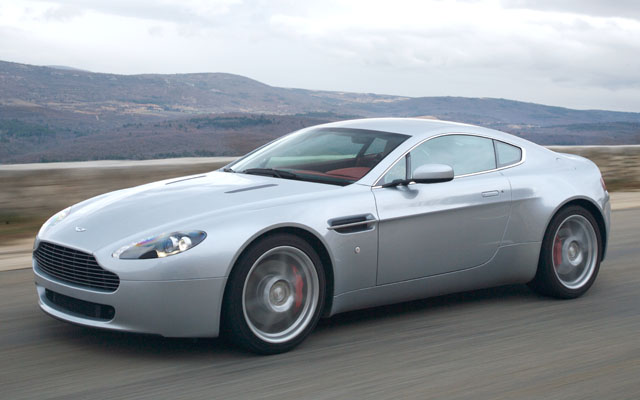
$ 129,500 - 129,500
(4) 2008 Jaguar S-Type

$ 62,000 - 86,400
(5) 2008 Ford Explorer

$ 41,399 - 53,699
(6) 2008 Lotus Exige

$ 67,750 - 73,995
(7) 2008 Infiniti FX

$ 55,050 - 62,950
(8) 2009 Audi TT Roadster

$ 49,900 - 59,800
(9) 2008 Toyota Avalon

$ 39,840 - 39,840
(10) 2008 BMW M6 Coupe

$ 128,300 - 128,300
(1) 2008 BMW M Roadster

$ 64,900 - 64,900
(2) 2008 Rolls Royce Phantom Drophead Coupé

$ 447,700 - 447,700
(3). 2008 Aston Martin V8 Vantage
$ 129,500 - 129,500
(4) 2008 Jaguar S-Type

$ 62,000 - 86,400
(5) 2008 Ford Explorer

$ 41,399 - 53,699
(6) 2008 Lotus Exige

$ 67,750 - 73,995
(7) 2008 Infiniti FX

$ 55,050 - 62,950
(8) 2009 Audi TT Roadster

$ 49,900 - 59,800
(9) 2008 Toyota Avalon

$ 39,840 - 39,840
(10) 2008 BMW M6 Coupe

$ 128,300 - 128,300


ane ei bn mu antimatama mage ekat me jatiye...mu 1 weniyata nemeda enna ona....
1st ekawa dekkama penawane mu 2nd kiyala


Similar threads


- Replies
- 61
- Views
- 3K


