there are 3 methods to solve it
google : 1 inverse matrix method
2 cramers rule
3 Gaussian elimination (with row echelon form)
Matricex system ekak solve karanna widi 3k thiyenawa,
1. Gaussian elimination
2. Cramer's rule
3. Inverse matrix method
Cramer's rule eka lesi habai hama welwakama eka karannath ba, matrix ekaka determiantion eka 0 unoth ba nattan eka use karapn eka lesi elimination and inverse ekata wada
Ado owa patta lesi bn.mtrix solve karanna widiha gena tyena video ekak balapan. Nettam daas ge potha balapan
thanikarama a/l maths ne.
Me pahala krame harida kiyahalloko ekenma.Mekata purudu unot one ekak solve karanna puluwn neh
me krame da use karanna one 1st 2nd ewa hadanna.
Solve for x, y and z in the system of equations below
Solution: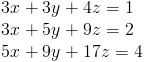
The first step is to turn three variable system of equations into a 3x4 Augmented matrix.
Next we label the rows of the matrix: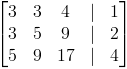
Since in the above augmented matrix we can't find any rows with one as the leading coefficient, we don't need to perform a row switching operation. However, we do need to modify row 1 such that its leading coefficient is 1.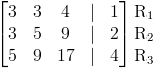
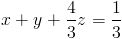
We can achieve this by multiplying row 1 by 1⁄3:
Next we need to change all the entries below the leading coefficient of the first row to zeros.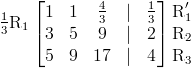
For the second row, we can achieve this by first multiplying through by-1⁄3 and then adding the result to row 1.
Adding the result to row 1: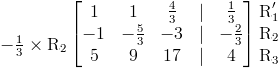
We then move on to row 3; here we multiply the row by -1⁄5 and then add the result to row 1 in order to zero out the first element.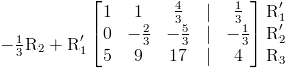
Adding the result to row 1: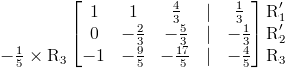
We need the leading element in the second row to also be one. We obtain this result by multiplying the second row by -3⁄2: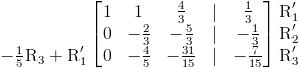
Next we zero out the element in row three beneath the leading coefficient in row two. To achieve this, we multiply the third row by5⁄4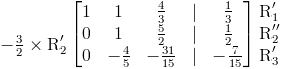
Adding the result to row 2: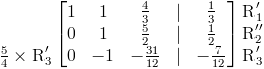
Finally we multiply row 3 by -12 in order to have the leading element of the third row as one: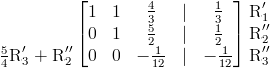
From the above matrix, we solve for the variables starting with z in the last row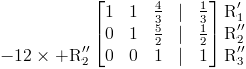
Next we solve for y by substituting for z in the equation formed by the second row:
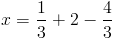
Finally we solve for x by substituting the values of y and z in the equation formed by the first row:


Therefore, the solution to the system of equations is {x,y,z} = {1,-2,1}