 Japan vala vune deflation machan unta passe abenomics kiyala salli achchu gahanna vuna
  Problems of Deflation
- Discourages consumer spending. When there are falling prices, this often encourages people to delay purchases because they will be cheaper in the future. In particular, it can discourage consumers from buying luxury goods / non-essential items, e.g. flatscreen TV) because you could save money by waiting for it to be cheaper. Therefore, periods of deflation often lead to lower consumer spending and lower economic growth; (this in turn creates more deflationary pressure in the economy. Certainly this fall in consumer spending was a feature of the Japanese experience of deflation (Japanese financial crisis).
- Increase real value of debt. Deflation increases the real value of money and the real value of debt. Deflation makes it more difficult for debtors to pay off their debts. Therefore, consumers and firms have to spend a bigger percentage of disposable income on meeting debt repayments. (in a period of deflation, firms will also be getting lower revenue, and consumers will likely to get lower wages). Therefore, this leaves less money for spending and investment. This is particularly a problem in a balance sheet recession where firms and consumers are trying to reduce their exposure to debt. Europe has a big burden of government debt, deflation will make it more difficult to reduce debt to GDP ratios.
- Increased real interest rates. Interest rates can’t fall below zero. If there is deflation of 2%, this means we have a real interest rate of + 2%. In other words saving money gives a reasonable return. Therefore, deflation can contribute to an unwanted tightening of monetary policy. This is particularly a problem for Eurozone countries which don’t have recourse to any other monetary policies like quantitative easing. This is another factor that can lead to lower growth and higher unemployment.
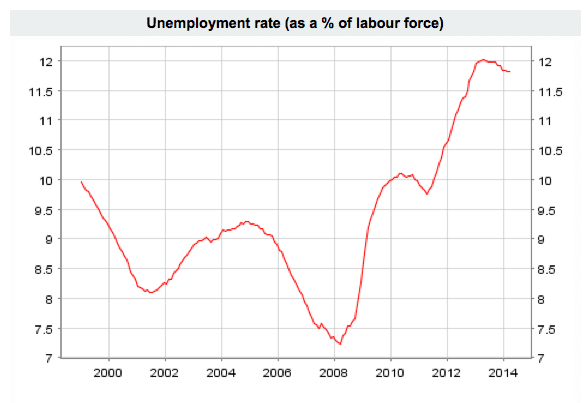
- Real wage unemployment. Labour markets often exhibit ‘sticky wages’. In particular, workers resist nominal wage cuts (no one likes to see their wages actually cut, especially when you are used to annual pay increases. Therefore, in periods of deflation, real wages rise. This could cause real-wage unemployment. Unemployment in Europe is a major problem – and low inflation is one reasons.
- More difficult for relative prices and wages to adjust. If the average prices or wages are increasing by 3%, it is easier for some goods to rise by 0% and some to rise by 6%. With inflation of 0%, it is harder to get this relative change in prices or wages.
- Deflation can become entrenched and difficult to end. The experience of Japan in the late 90s and 00s, was that when deflation became the new norm, it was very hard to change inflation expectations and regain normal growth.
Doesn’t deflation make us better off because things are cheaper?
Remember deflation usually means falling wages (or at least stagnant wages). It also means higher unemployment. People with debts, e.g. mortgages, credit cards are likely to feel the squeeze more. Prices may be falling, but the amount of money you have to spend is also likely to be falling.
Deflation is only good if prices are falling and your disposable income is rising.
It is true that some people, especially net savers, may feel better off during a period of deflation. But, the problem is the wider macro-economic consequences of recession and unemployment.
Problems of low inflation
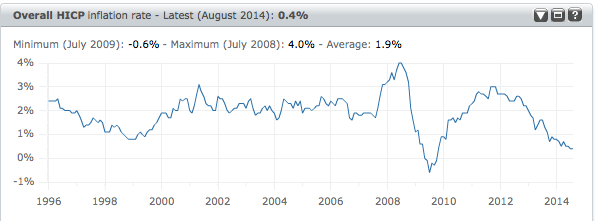
EU inflation falling to 0.4% in August 2014.
Deflation is quite rare, but increasingly common are periods of low-inflation – inflation below the government target of 2%. Even low inflation can be a real economic problem – though on a smaller scale than deflation. Problems of low inflation include:
- Increased real debt burden. If people expected an inflation rate of around 3-4%, they may take out debts, assuming a future inflation rate of 3-4% to help reduce the real value. However, if inflation is at 0.5%, the real value of the debt will fall much more slowly than expected. Governments will also struggle to reduce debt to GDP ratios because with low inflation, tax revenues will rise much more slowly than expected.
- Tight monetary policy. With inflation of 0.5%, and ECB interest rates of 0.5% – monetary policy is too tight harming the economic recovery. This is particularly a problem for Europe because they are reluctant to pursue quantitative easing.
- Difficulty of adjusting wages and prices. This is particularly a problem for the Eurzone where a fixed exchange rate mean countries like Spain rely on a prolonged period of falling prices to restore competitiveness.




 oya losses allanava ban meka lankavane


 Iye full tank gahuwa 5300 kata.


