

Latest ads
-
 Baseus PI LITE INDOOR CAMERA
- ErMurazor
- Updated:
-
Colombo Hard Disk For Sale
- mazza
- Updated:
-
 land for sale
- justasking
- Updated:
-
 AMD AM 5 Ryzen setup
- prabodhamadusanka
- Updated:
-
 Gampaha ACER OKW223 Wired RGB Keyboard
- chint
- Updated:
You are using an out of date browser. It may not display this or other websites correctly.
You should upgrade or use an alternative browser.
You should upgrade or use an alternative browser.


AL කාලේ කරේ.. දැන් මතක නෑඋඹටනං මේව සිම්පල් නෙ

මමාත් හැදුවේ මෙහෙම.. හැබැයි ඉදිරිපත් කරන විදිහ මෙහෙමද කියලා sure නෑ..
පට්ට ලේසි වැඩක්නෙ තිබිල තියෙන්නෙ


- Assumptions:
- a > b > d > 0
- Cross-multiplication:
- (a - d) / (b - d) > a / b
- (a - d)(b - d) > a(b - d)
- Expanding:
- ab - ad - bd > ab - ad
- -bd > -ad
- Dividing by the negative sign:
- bd < ad
- Dividing both sides by bd:
- 1 < a / b
- Conclusion:
- (a - d) / (b - d) > a / b
මේ මොකක්ද බං කරල තියෙන්නෙ
- Assumptions:
- a > b > d > 0
- Cross-multiplication:
- (a - d) / (b - d) > a / b
- (a - d)(b - d) > a(b - d)
- Expanding:
- ab - ad - bd > ab - ad
- -bd > -ad
- Dividing by the negative sign:
- bd < ad
- Dividing both sides by bd:
- 1 < a / b
- Conclusion:
- (a - d) / (b - d) > a / b

මේ මොකක්ද බං කරල තියෙන්නෙ
මෙතන වැරදියි නේ මචං
- Assumptions:
- a > b > d > 0
- Cross-multiplication:
- (a - d) / (b - d) > a / b
- (a - d)(b - d) > a(b - d) <----
- Expanding:
- ab - ad - bd > ab - ad
- -bd > -ad
- Dividing by the negative sign:
- bd < ad
- Dividing both sides by bd:
- 1 < a / b
- Conclusion:
- (a - d) / (b - d) > a / b

Ok, lets try,
First, let's prove the left side of the inequality,
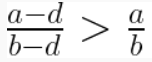
Cross-multiplying the inequality gives:
(b - d) × (a / b) > (a - d)
Expanding both sides of the inequality:
(a * b - d * b) > (a * (b - d) - d * (b - d))
Simplifying:
(a * b - d * b) > (a * b - a * d - d * b + d^2)
The b terms cancel out:
(a * b - a * d) > (a * b - a * d - d * b + d^2)
Simplifying further:
-a * d > -d * b + d^2
Dividing both sides by -d (remembering that d is positive):
a < b - d + d^2 / d
a < b - d + d
a < b
Since a > b, this inequality is not true. Therefore, the left side of the original inequality is false.
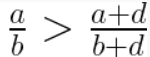
Next, let's prove the right side of the inequality
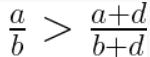
Cross-multiplying the inequality gives:
b * (a / b) > a + d
Simplifying:
a > a + d - b
-a > d - b
Since b > d, the right side of the inequality is not true. Therefore, the right side of the original inequality is false.
Since both sides of the original inequality are false, we cannot prove the given inequality using the provided conditions a > b > d > 0.
First, let's prove the left side of the inequality,
Cross-multiplying the inequality gives:
(b - d) × (a / b) > (a - d)
Expanding both sides of the inequality:
(a * b - d * b) > (a * (b - d) - d * (b - d))
Simplifying:
(a * b - d * b) > (a * b - a * d - d * b + d^2)
The b terms cancel out:
(a * b - a * d) > (a * b - a * d - d * b + d^2)
Simplifying further:
-a * d > -d * b + d^2
Dividing both sides by -d (remembering that d is positive):
a < b - d + d^2 / d
a < b - d + d
a < b
Since a > b, this inequality is not true. Therefore, the left side of the original inequality is false.
Next, let's prove the right side of the inequality
Cross-multiplying the inequality gives:
b * (a / b) > a + d
Simplifying:
a > a + d - b
-a > d - b
Since b > d, the right side of the inequality is not true. Therefore, the right side of the original inequality is false.
Since both sides of the original inequality are false, we cannot prove the given inequality using the provided conditions a > b > d > 0.
Attachments
අමාරුවෙන් ගාණක් හදන අපට ඇයි උඹ මෙහෙම කරන්නෙOk, lets try,
First, let's prove the left side of the inequality,
View attachment 205861
Cross-multiplying the inequality gives:
(b - d) × (a / b) > (a - d)
Expanding both sides of the inequality:
(a * b - d * b) > (a * (b - d) - d * (b - d))
Simplifying:
(a * b - d * b) > (a * b - a * d - d * b + d^2)
The b terms cancel out:
(a * b - a * d) > (a * b - a * d - d * b + d^2)
Simplifying further:
-a * d > -d * b + d^2
Dividing both sides by -d (remembering that d is positive):
a < b - d + d^2 / d
a < b - d + d
a < b
Since a > b, this inequality is not true. Therefore, the left side of the original inequality is false.
Next, let's prove the right side of the inequality
View attachment 205863
Cross-multiplying the inequality gives:
b * (a / b) > a + d
Simplifying:
a > a + d - b
-a > d - b
Since b > d, the right side of the inequality is not true. Therefore, the right side of the original inequality is false.
Since both sides of the original inequality are false, we cannot prove the given inequality using the provided conditions a > b > d > 0.


Last edited:
හරස් ගුණ..මේ විදියට සුලු කරගන්නෙ කොහොමද?
@dilann

කොහොමද බං උඹලට මේව කල්පනාවට එන්නෙ. මාර හැදිල්ලක් හදල තියෙන්නෙ
මම දැං තමා බලල බලල මේක තේරුම් ගත්තෙ

@McGayan
Last edited:


Similar threads

- Replies
- 26
- Views
- 501


- Replies
- 6
- Views
- 269


